
Not one shot fired. Not one person hurt. Not one dime of damage.
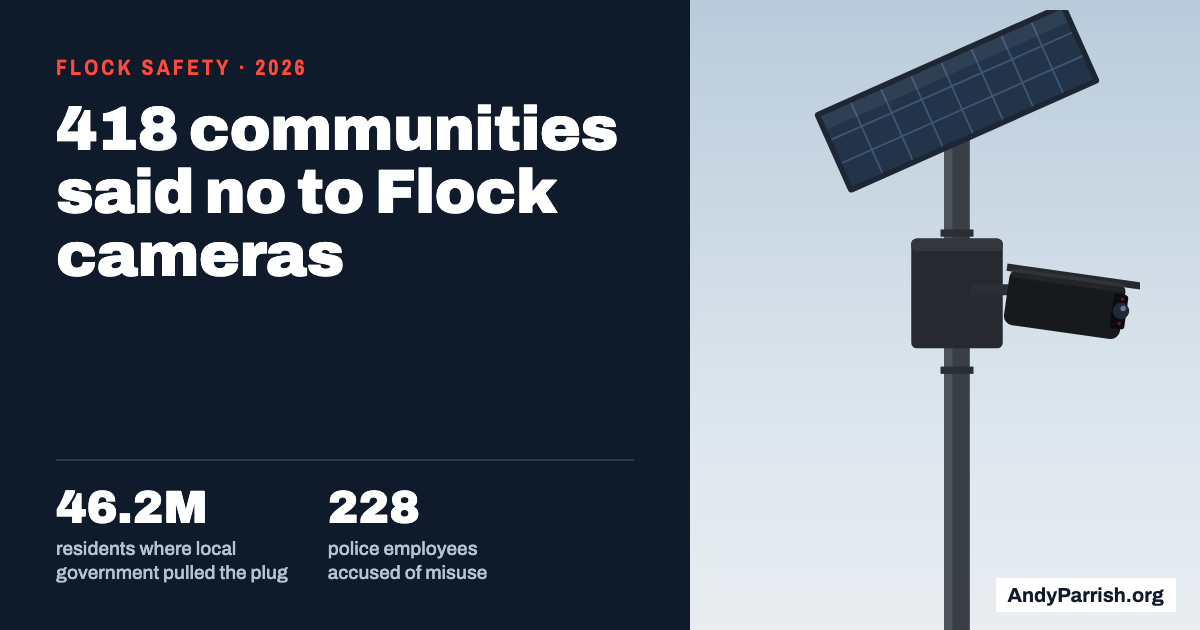
In 2026, 418 cities, counties, sheriff’s offices, school districts and college campuses canceled, rejected, paused or shut off Flock Safety license plate cameras.
Together they’re home to 46,180,650 people. That’s roughly one in every seven Americans living somewhere their local government decided to stop feeding a private company’s searchable database of where they drive.
This was done the lawful way. The most powerful weapon ever made isn’t a rifle. It’s a regular person at a public-comment microphone with three minutes and the facts.
The year in three numbers
418 communities said no. I put the list together from three independent trackers (DeFlock The USA, Who Approved This and Finding Flock), removed the duplicates, and then added actions the trackers had missed. That included La Crosse. Every entry is dated in 2026 and linked to its source.
The list covers 43 states. It includes big cities like Los Angeles, Denver and San Diego, and towns most people couldn’t find on a map. Five of the entries are school districts, including Cleveland’s, and seven are colleges.
46,180,650 people. I matched every city, town and county to the Census Bureau’s 2024 population estimates. When a city and its county were both on the list, I counted those residents once.
- 27,233,753 people live where Flock was ended outright: canceled, not renewed, rejected or removed.
- 18,946,897 live where it was paused, suspended or partly shut off. Most of these are Florida counties that pulled cameras off state roads after the state transportation department’s August order, plus cities like Dallas and San Diego.
228 police employees accused of misuse. This is the number Flock’s sales team doesn’t put in the brochure.
In 2026, 228 law enforcement employees were publicly accused of misusing Flock. Of those, 112 were arrested or criminally charged. The rest were fired, resigned, suspended or put under investigation.
Some examples from the record:
- Lufkin, Texas: An officer was sentenced to five years after pleading guilty to 100 felony counts. He’d used Flock to track an ex-girlfriend, her family and others in her life.
- Hancock County, Indiana: A deputy faces 441 felony counts over about 6,190 searches. His targets included his wife and former girlfriends.
- Albany County, New York: A senior investigator is accused of about 4,000 unauthorized searches, roughly 3,000 of them on an ex-girlfriend’s car.
- Georgia: The Georgia Bureau of Investigation alone announced 15 rounds of arrests for plate-reader misuse between July and November.
Not every case is about stalking. Some officers looked up their own plates or their relatives’. But dozens are accused of tracking exes, spouses and people they were romantically interested in.
72 of the 228 are listed as “Unnamed” because their departments wouldn’t release a name.
Wisconsin wasn’t on the sidelines
Wisconsin has 35 entries on the list, covering about 1.65 million residents including Trempealeau County:
- Dane County cut its funding on a 32–1 vote.
- Kenosha ended its program.
- Appleton stopped using the system after it lost trust in it.
- Fitchburg, Oshkosh, Sheboygan, Racine and a string of Fox Valley agencies dropped or paused Flock.
In October, La Crosse joined them. The police department said it couldn’t accept the risk of sharing a network with agencies that lack consistent accountability. River Falls cited “a loss of confidence in Flock Safety as a service provider.” De Pere’s contract ran out Nov. 15.
Wisconsin also produced its share of misuse cases:
- A Milwaukee officer pleaded guilty after 179 searches on a woman he was dating and her ex.
- A Menasha officer was sentenced to six months in jail.
- A former Kenosha County deputy is charged with two felony counts of misconduct in public office.
Then there’s Arcadia
Three Flock cameras are still running in Arcadia, a Trempealeau County city of 3,737 people.
The questions are the same ones every one of those 418 communities eventually asked:
- Who approved the cameras without an oversight policy?
- What policy governs who can search the data?
- Which outside agencies can see it?
- Who’s checking the audit log?
What the record shows, and what it doesn’t
- “Pulled the plug” isn’t the same as “invisible.” Residents of these 418 communities can still be photographed by privately owned Flock cameras at HOAs and big-box stores, by state systems, and by neighboring towns’ cameras.
- Some cancellations came undone. Cleveland, the city, reversed itself and kept Flock. Flock reinstalled cameras in Evanston, Illinois and Dayton, Minnesota after officials told it not to.
- The paused tier may not stay paused. Several Florida counties could switch cameras back on.
Even so, the direction of 2026 is clear. Communities that looked at the contract, the sharing settings and the audit logs mostly didn’t like what they found.
What you can do
Find out whether your city, county or school district has a Flock contract. Then ask for three records – you can also use the template at andyparrish.org/flock-toolkit
- The contract
- The list of outside agencies with access
- The last 90 days of the audit log
See the full list: every agency, every officer and every source is in the downloadable spreadsheet.